Surface revision 2026.03.26

Atlas OS

The control system for molecular diagnostics.

Precision medicine is advancing faster than the operational systems around it. Atlas OS turns fragmented diagnostic workflows into one operating surface across intake, coordination, execution, reporting, interoperability, and increasingly automation-ready control.

Built inside live Atlas workflows, it already supports bounded operator action today and is being extended into a partner-deployable operating layer for cross-network execution.
  • LIVE NOWRunning inside Atlas production workflows.
  • CONTROL MODELBounded operator action with auditable decision points.
  • NEXTPartner-deployable operating layer for cross-network execution.
WHY THIS EXISTS

Precision medicine will not become standard care through better science alone. It also requires a new operating infrastructure. Atlas is being built as that foundation.

The goal is to make advanced diagnostics and personalized treatment operationally scalable -- so they can become faster, more reliable, and materially more accessible over time.

M-02

Demo

Atlas OS

Optional walkthrough module showing Atlas OS in motion.

M-03

Atlas OS Product Stack

Atlas OS

Atlas OS combines five control layers into one molecular diagnostics operating system. What begins as workflow software at the front door expands into a system that can understand, coordinate, and increasingly act across the diagnostic lifecycle inside one lab, across multiple labs, and across the wider care and research ecosystem.

L1

Knowledge System

Indexed clinical and operational context

What this enables: faster interpretation, fewer repeated decisions, and more consistent execution across users and sites.

L2

Agents

Bounded workflow reasoning and action support

What this enables: blocker detection, draft communications, writeback preparation, routing, and safe next-step advancement.

L3

Vision Layer

Physical-to-digital intake and sample interpretation

What this enables: the lab can be seen, interpreted, and structured without relying only on manual entry.

L4

World Model

Real-time map of dependencies, holds, reserves, and execution state

What this enables: earlier detection of blockers, better routing, and a path toward increasingly autonomous execution.

L5

Interoperability Fabric

Cross-lab routing, specialist handoffs, and status continuity

What this enables: one continuous operating surface even when work moves across multiple organizations.

Most software in diagnostics addresses only one layer of the problem. Atlas OS connects knowledge, reasoning, perception, control, and interoperability into one software-defined system.

M-04

Product Screens / Surfaces

Atlas OS
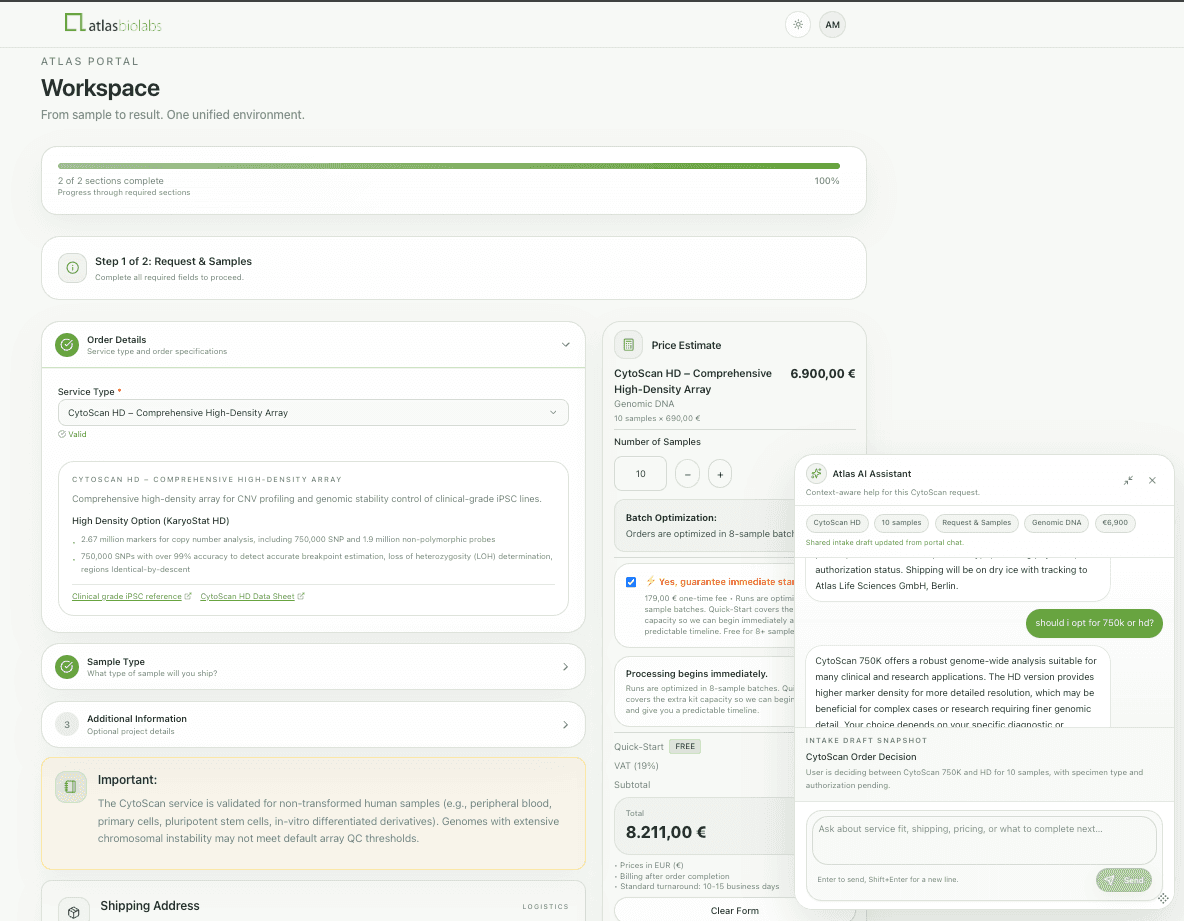
Customer Workspace
P-01

Customer Workspace

Structured order intake, quoting, and request guidance
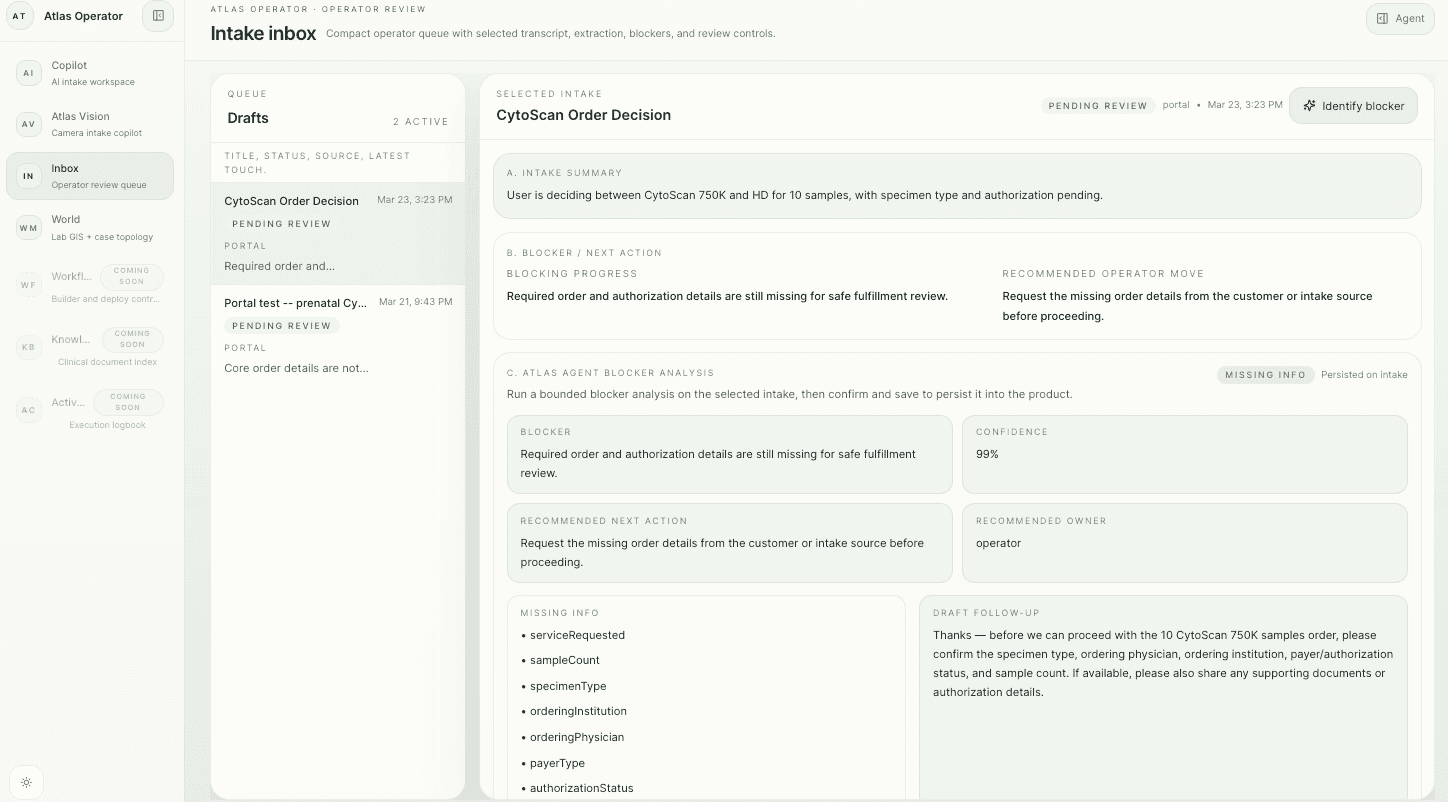
Intake Inbox
P-02

Intake Inbox

Compact operator review queue with blocker analysis and follow-up drafting
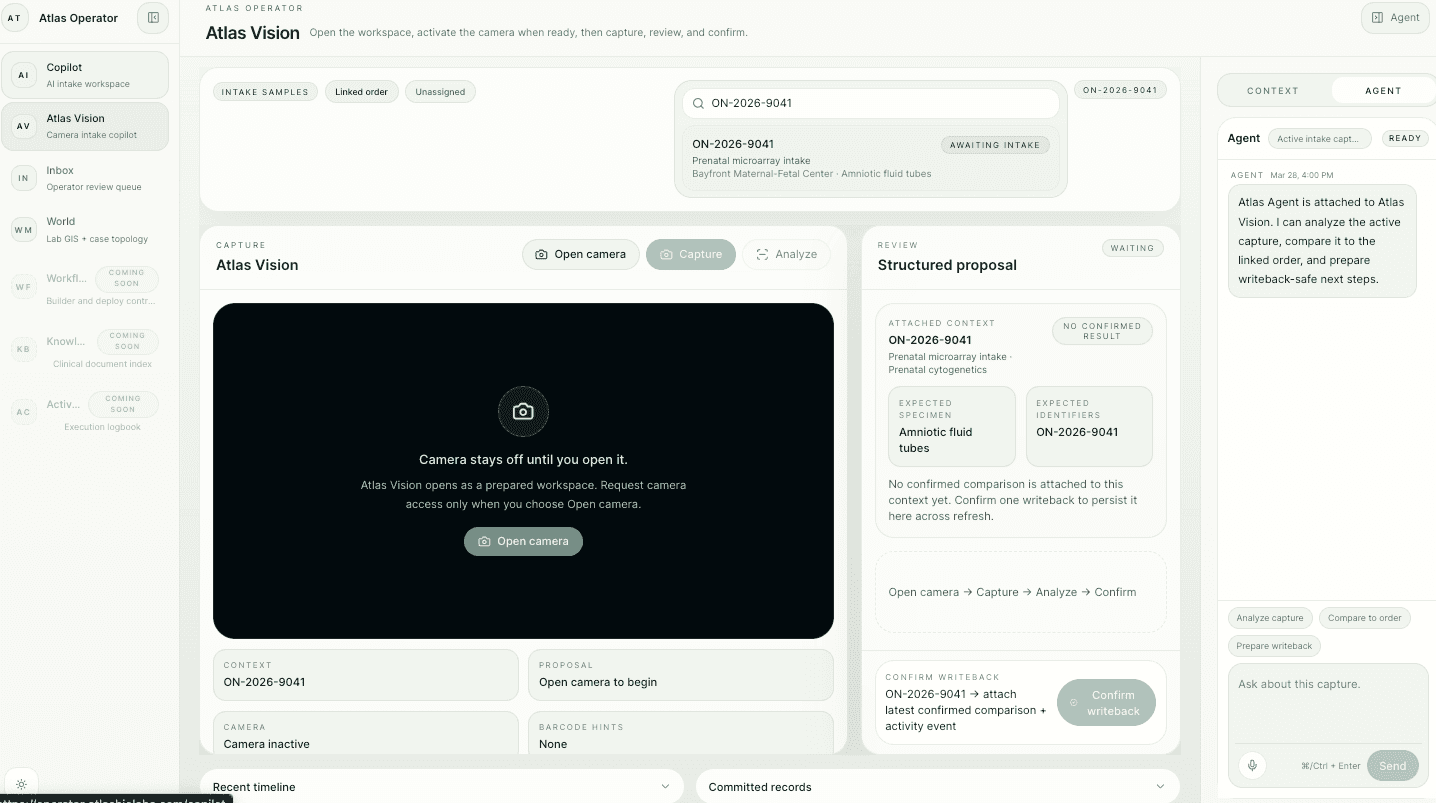
Atlas Vision
P-03

Atlas Vision

Camera intake agent linking capture, review, and writeback-safe proposal flow
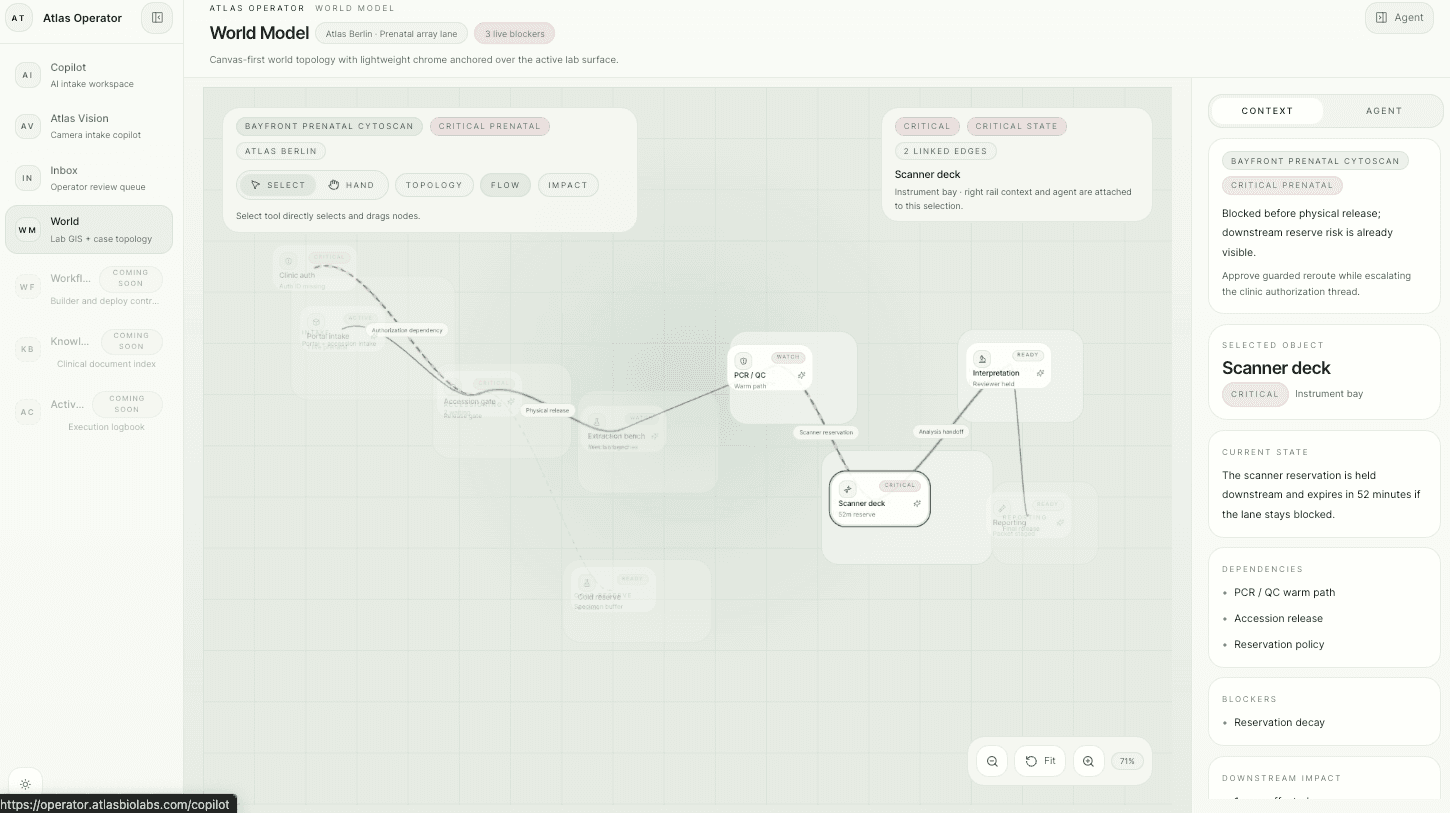
World Model
P-04

World Model

Lab topology and dependency surface for context, blockers, and downstream impact visibility
M-05

Current Workflow Coverage

Atlas OS

Question answered: which workflow stages Atlas OS currently structures, coordinates, and carries through from intake to delivery.

REQUEST INTAKELAB OPERATIONSEXECUTION RUNTIMEDELIVERY LOOPREQUEST INTAKEQ 142ACCESSION + QCQC 129PREPARATIONPREP 124INSTRUMENT RUNRUN 116INTERPRETATIONANA 113REPORTINGREP 110CLINICAL RELEASEREL 107

Atlas OS currently spans intake, preparation, execution, interpretation, reporting, and release continuity across the internal lab workflow.

Current role: operating layer across intake, preparation, execution, reporting, and delivery continuity

Deployment basis: production behavior observed in live Atlas lab workflows

Agentic behavior today: identifies blockers, drafts communications, prepares writebacks, and advances bounded workflow steps under operator oversight

Expansion logic: deepen workflow authority and convert Atlas-internal control patterns into partner-deployable modules

M-06

OS Architecture

Atlas OS

How Atlas Operator functions as a closed-loop operating system for lab perception, planning, execution, and improvement.

OBJECTIVES / CONSTRAINTSturnaround • correctness • compliance • safety • throughput • traceability • integrationATLAS OPERATOR RUNTIMER-01PERCEPTIONinbox / chat intakeR-02WORLD MODELvision / camera • system signalsdocument extractionR-03PLANNERnext best action • prioritization logicescalation • hold / routeR-04EXECUTIONagent actions • writeback / notify • update recordsREALITY LAYERIN-01• clinic / customer inputs• physical samples• humans in the loop• external systems• LIMS / portal / instrumentsOPERATIONAL REALITYOUT-01• humans act• lab state changes• records update• outcomes happenOPERATOR OVERSIGHTCTRL-01approve / rejectedit / constrain actionconfirm writebackLEARNING / MEMORY / AUDITFB-01event log • outcomes • operator corrections • policy updatesmemory signals improve future planning + executionOBSERVATIONSCONSTRAINT / APPROVALOUTCOME / FEEDBACK

Closed-loop logic: observations enter runtime, actions are constrained by oversight, outcomes feed memory, and memory updates improve future planning and execution.

M-07

Live Today / In Development

Atlas OS

Question answered: which capability modules are production-ready, actively shipping, and queued next.

Execution posture: Atlas can move from visibility to bounded action by escalating blockers, drafting operator-ready comms, preparing system writebacks, and advancing safe workflow tasks.

LIVE TODAY

Production control modules
Order intake + request parsing

EDGE.INTAKE

92%
Workspace triage + queueing

OPS.WORKSPACE

88%
Customer status relay

CX.SIGNAL

84%

IN DEVELOPMENT

Active delivery sprint
Sample orchestration logic

LAB.CORE

63%
AI pre-structuring assistant

AI.CONTROL

58%
Partner deployment templates

NET.EXPANSION

52%

NEXT CONTROL WAVE

Queued expansion modules
Cross-lab SLA balancing

NET.ROUTING

41%
Exception auto-remediation

OPS.RECOVERY

36%
Provider-facing command portal

CX.SURFACE

29%
M-08

Control Progression

Atlas OS

How Atlas OS deepens from structured intake to bounded operational control.

visibility → coordination → continuity → bounded control

L1

Structured Intake

Request normalization, typed intake contracts, source adaptersCan structure incoming work
L2

Guided Coordination

Blocker detection, routing logic, draft preparation, bounded next-step supportCan propose safe next actions
L3

Stateful Continuity

Status continuity, writeback, reporting, delivery intelligenceCan preserve state across the workflow
L4

Bounded Control

Dependency-aware execution, holds/reserves, exception handling, automation-ready actionsCan govern execution under bounded autonomy
M-08A

Why Atlas Operator gets stronger at scale

Atlas OS

Question answered: why manual and half-digitized lab operations become unstable at scale, while Atlas Operator improves with complexity.

The system is not designed merely to digitize existing work. It is designed to preserve operational stability as volume, complexity, and coordination load increase.

Operational stability vs. scale

FragileStableResilientInstability thresholdCoordination ceilingOperational stability / throughput qualityOperational scale / complexity / coordination loadManual systemDigitized non-AIAtlas OperatorLow loadCoordination burdenCross-system complexityScaled runtime

Structured intake

Normalizes incoming work before instability accumulates.

Effect: fewer intake-rework loops.

Operator guidance + validation

Identifies blockers, proposes safe next actions, and preserves execution quality.

Effect: lower review drift under rising complexity.

System memory / writeback

Persists state, actions, and outcomes so the system improves over time.

Effect: continuity across handoffs, retries, and downstream steps.

As complexity rises:

  • manual systems accumulate rework
  • digitized non-AI systems hit a coordination ceiling
  • Atlas Operator preserves execution quality under load
M-09

Distribution

Atlas OS

Question answered: Atlas sells from inside a live workflow, not from outside the market.

live lab → installed base → workflow pull → modular deployment

2,000+ historic customer relationshipsLive lab first deployment environment4-phase rollout logicPartner-lab deployment path
Commercial Thesis

Two commercial layers, one operating model.

  • Live, revenue-generating molecular diagnostics business
  • Atlas OS deployable across labs and their customers
  • Product decisions shaped by in-workflow pain, not outside assumptions
Proof line: Atlas builds and sells from the same operating environment.
Installed Base

Atlas enters with a real commercial graph, not a cold start.

2,000+ historic customer relationships
  • Reactivation path from prior served customers
  • Expansion path into adjacent labs and workflow environments
  • Systemized deployment starting from known accounts
Proof line: Existing relationships compress trust and cycle time.
Sales Motion

Commercial pull is already present in workflow channels.

  • Product pull from Atlas’ own customers
  • Exposure through partner-lab workflows
  • Selective direct conversations with relevant labs and partners
Proof line: The product is encountered in real workflows before formal sales cycles.
Deployment Logic

Land where friction is highest, then expand in phases.

  • Phase 1 -- Front door and intake
  • Phase 2 -- Workflow coordination
  • Phase 3 -- Reporting and delivery
  • Phase 4 -- Efficiency and control
Proof line: Repeatable rollout without day-one rip-and-replace adoption.
M-10

Ecosystem Surface

Atlas OS

How Atlas OS operates between human decision-making, lab execution, automation-ready workflows, and cross-institution interoperability.

DEMAND + HUMAN LAYERATLAS OS OPERATING LAYEREXECUTION + NETWORK LAYERCLINICSPHYSICIANSCARE NAVIGATIOND2C / DIGITAL FRONT DOORSHUMANS IN THE LOOPINTAKE + COORDINATIONWORLD MODEL + ROUTINGSTATE CONTINUITYOPERATOR OVERSIGHTWRITEBACK ORCHESTRATIONINTEROPERABILITY FABRICPARTNER LABSRESEARCH HUBSBIOBANKSLAB CHAINSAUTOMATION SUITESHUMAN-GUIDEDSOFTWARE-COORDINATEDAUTOMATION-READY + CROSS-SITECORE STATE BUS / GUARDED ROUTINGHUMAN INPUT CHANNELSDISTRIBUTED EXECUTION CHANNELSHuman decision pointsBounded autonomy with oversightDistributed execution continuityHUMAN-GUIDED -> SOFTWARE-COORDINATED -> AUTOMATION-READY -> CROSS-SITE INTEROPERABLE
M-11

Competitive Landscape

Atlas OS

Question answered: Atlas spans the workflow continuously while alternatives cover fragmented bands.

Workflow bandLIMS / LISMarketplacesPoint toolsAtlas OS
Front-door intake
Execution orchestration
Customer status loop
Partner interoperability
M-12

Economics Model

Atlas OS

Question answered: how workflow compression changes lab economics across savings, capacity, and implementation payback.

Lab type

Annual savings vs. recurring platform costModeled from minutes saved per sample, sample volume, loaded lab ops cost, and Atlas OS pricing tier.€0€640,000€1,280,000€1,920,000€2,560,000€3,200,000Break-even 9.8 min051015202530€ / yearMinutes saved / sampleAnnual labor savingsAnnual recurring platform cost

At 12 minutes saved per sample, Atlas OS implies €1,080,000 in annual labor savings, €198,500 in net operating gain, and roughly +800 additional samples of monthly capacity per operator FTE.

Annual labor savings

€1,080,000

€ value / year

Annual net operating gain

€198,500

€ value / year

Additional capacity / operator FTE

+800

samples / month

Implementation payback

1.7 months

modeled from implementation fee and labor savings

Tier constants: implementation fee €150,000, annual recurring revenue €881,500, gross margin 84%.

M-13

Supporting Materials

Atlas OS

Detailed financial and strategic materials are shared separately via direct access links. Access may vary by recipient.

MAT-01

Business case / financial model

Scenario-based Atlas OS business case

MAT-02

Management overview

Condensed management summary + deep dive